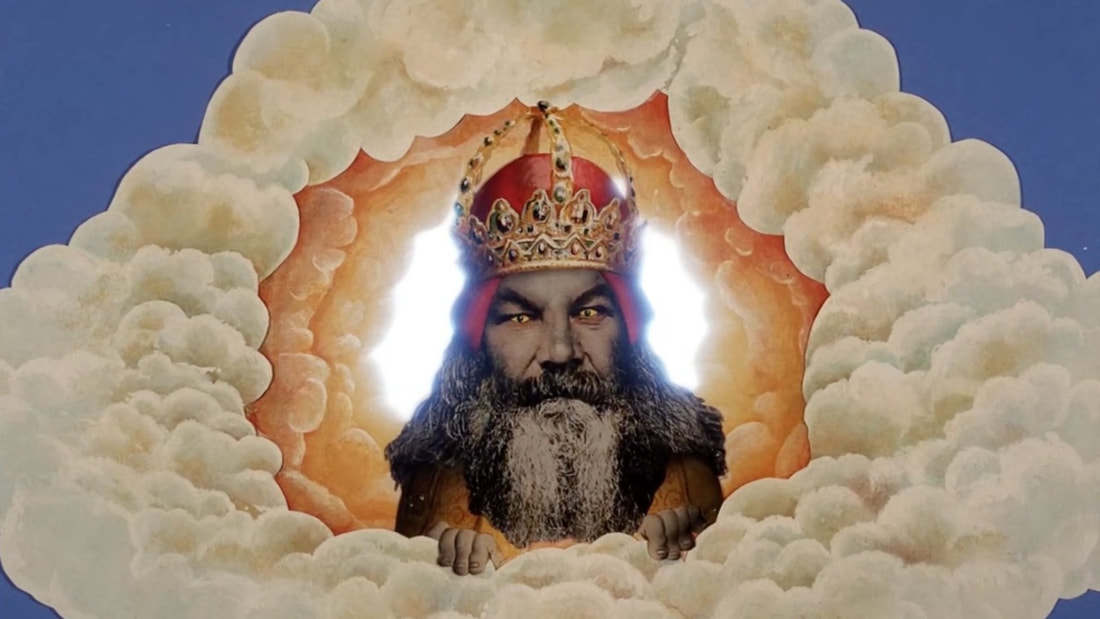
Perhaps the greatest testament to silliness of the 20th century. The first 28 minutes after the opening credits end are some of the funniest yet on film.
There is a naivete and friendliness to this movie that pairs explosively with its casual and psychedelic gutting of foundational British symbolism. This felt like a kid roasting their parents in a way that will absolutely get them grounded. The opening of this film is a drive-by, head-down evisceration of some of the pillars of British society (religion, monarchy). This is a roast of medieval culture, which should probably be an entire genre. Roasting medieval culture works so well because we are really not so far removed from it, yet we like to think we are.
What makes this so agreeable, and hold up so well, is that there is nothing mean happening here. With few exceptions, the humor is either self-effacing, world-effacing or just entirely absurd – it’s never directed at an individual. This is not revealing or exaggerating some cynical opinion about the world (which is what comprises much of modern humor), but is instead exaggerating and fabricating aspects of the troupe’s own culture’s origin story. It is only implying judgment of modern practices through lampooning ancient practices of the same culture. There is an explicit payload of social commentary, but by keeping true to its own premise unironically (up until it doesn’t), the movie itself provides a powerful bank of memes that can be used to express cynical or ironic opinions about the modern world, and this may be why it has found such a home with outsiders, especially.
The coconuts being used to suggest horses is a lean, powerful and timeless icon for “the suspension of disbelief”. Graham Chatman as King Arthur is the funniest of the main crew, feebly and agreeably authoritarian. Terry Gilliam grimacing maniacally and fixedly clacking away on the coconuts while he and King Arthur ‘ride’ through the moors is perfect filmmaking at the opening, just bursting with intention, chemistry and untargeted irreverence. John Cleese is probably the most talented of the crew and his are the best solo scenes, and his secondary characters are the most memorable (the black knight, the French guard, the “she turned me into a newt” peasant).
The Camelot scene is a perfect example of how humor in literature sometimes does a thing where the premise lags and you say “Ok, I get it, yep”, but then the movie, or book, or whatever, dives even deeper into the same gag with more bravado and it becomes a whole level funnier than it was before. I noticed this working in The Jerk as well, and Mr. Bean comes to mind. But this is an old-school humor methodology that requires a strong performance and a long attention span from the audience to really pay off – I don’t seem to see it as much in high-brow humor anymore. In the Camelot scene, this redoubling moment happens right as the musical bridge kicks off and three knights break the table they are dancing on, and so a new lower-angle shot shows the broken, slanted table with the same knights dancing even harder during a percussion breakdown. This is my favorite kind of humor in recent years – earnestness and silliness from characters who are only emboldened to act more and more like themselves as events progress. Leaning into “logical lame” and riding it like a wave.
There’s something about the timing of successive comedic beats in this movie especially, that reminds me of how when two people are jumping on a trampoline together, the exact timing of the bounces have non-linear impacts on the amount of force transferred between the bouncers. Having a second slapstick commence just before the last slapstick ended in the viewer’s mind can create a temporary comedic fugue state, a delightful buffer overflow. That’s the sweet spot, and it’s different for each person, and it could be determined for therapeutic purposes. The same is true of dramatic beats. It is possible to equip people with the ability to speed up or slow down the timing of their media playback programmatically, via a toggle of the playback speed itself or as something that slows down or speeds up the playback speed of the comedic or dramatic beats (reducing or expanding the “space between the notes”). A movie could be “tailored” to match the timing preferences of each individual viewer’s perception through a feedback and optimization system. This idea is related to “The People’s Cut”.
The dialogue has so many golden nuggets. This was the most quoted movie from my childhood, excepting only Jurassic Park. “Good Idea, o Lord!”, “Of COURSE it’s a good idea!” (same actor playing both roles). When did having single actors play multiple roles go out of style? It’s especially well suited for comedy.
The animation is auteur magic, perhaps more influential than even the non-animated parts of the movie. God in the cloud is perfect. Hand-animated art differs from most modern animation in the same way that puppet animals differ from cgi animals – you can see the soul of the animator in the motion and content of the hand-animation, whereas as soon as a computer is introduced to produce a visual component or a movement path, the uncanny valley yawns open. By having ragged, imperfect handmade elements and movements, the imagination of the creator is directly represented. Once an element is smoothed out by a computer, much of the expressive power is drained.
The costumes are amazing – funnier perhaps than those in “The Jerk”. Bedever constantly re-opening his face plate with a look of aloof calculation. The editing is so effective – it’s brisk and expressive and dramatic. The cutaway shots are very well timed to counterpoint the dialogue. The cinematography is also pitch-perfect – evocative shots that dwarf the actors beside real, dime-a-dozen castles, low angles at all the right moments.
The main theme is great, and the sound design in general is very funny – one moment comes to mind is of the bride being pampered before her wedding in the end of the film – soft giggling and whispering, fabric swishing, like sarcastic yet earnest asmr, not cracking a smile or waiting a beat to point to a meaning other than the exaggeration of reasonable behavior.
After the failed Trojan Rabbit joke, the main plot splits, the chemistry evaporates because the troupe is isolated from each other for gags with extras. The plot loses focus, the writing slackens, and we have to spend solo time with Eric Idle. The jokes stop relying on non-sequitur or silliness and instead choose topics to needle. The sexual tension scene in the castle Anthrax is almost entirely unfunny, it feels like an ancient tight-rope act over long-dead sharks. It perks up a bit once the gang reunites, especially for the scene with Tim the sorcerer, and the inventiveness and simplicity of the timpani-build repeated-headlong-assault-shot as John Cleese storms the castle is hard to overstate, but by the end of this movie I’m always feeling like falling asleep and not finishing my homework that’s due tomorrow.
The last 20 minutes pale in comparison to the beginning. The real-world bleed-through and meta non-ending were in vogue at the time (Blazing Saddles) and it does not serve to heighten the comedic tension. Uneven, flaky and half-baked, but some of the best comedy yet.