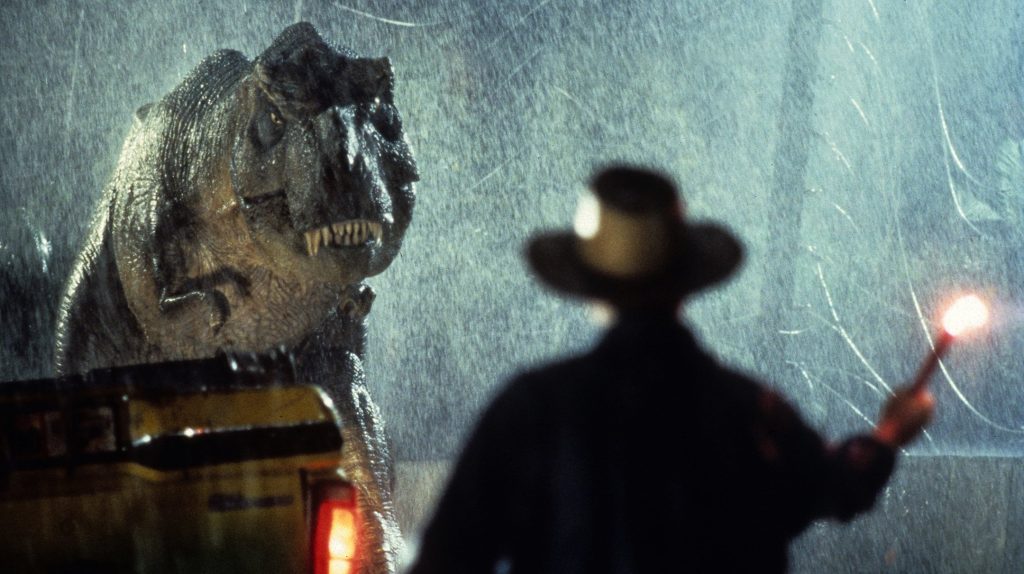
Jurassic Park (1993)
A grandiose, balanced, jacked, compleat, nuanced, spectacular, iconic pop reduction of the promethean story, for the whole family! The characters are cartoonishly simple and singular in their motivations, yet are written, acted and directed to a naturalistic foam of comic-book sci-fi horror that goes down like ice cold milk. Horror is definitely central here, yet this movie is too much fun to feel horrified. Sentimental, allegorical, slick, endlessly quotable, subtly campy in a mesmerizing, actuated tuxedo (which occasionally squirts you from a conspicuous dinosaur corsage). The blocking action was masterful, some of the best ever, and the dialogue is so memorable, clean, mythic, the characters are rich, simple and bold. This premise is inevitable but brilliant, and its translation to a Hollywood monster film is pitch-perfect.
I have been actively idolizing this film, but I had not seen it in nearly 20 years, and I’m happy to see that it didn’t wilt. Of course, it’s of limited scope – there is no social justice being achieved or talked about here, for example. But what it shoots for, it hits every time. This was not perfect, although I very much wanted it to be. A couple complaints: the brachiosaurus-sneeze tree was a Gumby, stagey, papier-mâché monstrosity – you can make studios full of realistic, life-size dinosaurs with articulated assholes but you can’t make (or find, or buy) a stationary goddamn tree?
The beams-of-light dinner where Malcom gives his prediction about the follies of the park was a brilliant bit of chiaroscuro, and a satisfyingly juicy bout of characterization, but Malcom’s diatribe about genetic power as ‘a kid with his dad’s gun’ felt overstated and even trite given that the outcome of the science is just dinosaurs at this point (for context, Grizzly, Lions and Orca, like dinosaurs, are absolutely deadly, totally outclassing humans in every physical comparison, yet are tormented in zoos without logistical issues). The anthropomorphization of capital-n Nature as something that “selects for” extinction seems incongruous with Malcolm’s character: are we to believe this is a chaos theoretician who believes that Nature’s “selections” are something more than a mere cookie’s crumbling? His worries do indeed seem a bit alarmist as compared to the dangers of modern genetic manipulation techniques like CRISPR.
The themes are straightforward but rich, skillfully laid, and still pertinent. The runaway powers of science, the terror of raising children (Grant’s arc is all about kids, and the whole movie could be read as a parable on progeny), the allure of the cutting edge, the subservience of science to profit, and the inevitability of system failure when cooperation is cobbled together with money and not grown from goodwill (i.e the failures of capitalism). I only just noticed the photo of Oppenheimer on Nedry’s desk (having just watched Oppenheimer) – that really should have been a red flag for someone of Hammond’s generation.
The technical prowess of this film is hard to overstate. The practical effects look significantly better than any creature effect in any movie since, and this movie is over thirty years old (and this includes the steeply imploding sequels). This was the last great watershed moment for animatronics in cinema, until the next one, which may still be decades away. Until then, we will have to watch CGI progress, at ever greater expense, down the same old asymptotic, uncanny valley. If ever that quarry is bagged, we may find no remaining appetite for it (in the same way that someone forced to squint for years cannot appreciate the dusk).
The sound design is wonderful throughout. The dinosaur noises are unfamilar but instantly believable, the sounds of the spoon hitting the ice cream saucer: I can just about hear the beans in the vanilla. And of course, the score is beautiful, thrilling, fitting, iconic and captures the naive beauty and grandeur of Hammond’s vision, without ripping off some other composer (which is often my complaint with John Williams).
My favorite scene was during the car tour where Malcolm is macking on Satler, and Grant is so absorbed in the possibility of seeing a dinosaur, and so comfortable in his relationship with Satler, that he doesn’t even notice and does not rebuff Malcolm’s advances, the chemistry is so real but obviously doomed to implode between Malcolm and Satler – the fact that the car is driving itself and the characters get out of the car one by one until Malcolm is left alone bullshitting by himself is just masterful writing. Lots of really subtle direction to flesh out really simple characters, and so this is both easy yet rewarding to follow. Deep sets. The shot of the T-rex roaring in the background while Timmy is in the upside-down car sinking in mud was spectacular, among a trove of nearly perfect practical effect shots. The CGI was good enough to be presented alongside these best-ever animatronics, but the animatronics do steal the show and leave us wishing that they had just built the full-body mechanical brachiosaurus.
Given the fact that they were typically not driven, cars featured prominently in this movie as set pieces (cars on the tour, car in the mud, car in the tree, jeep being chased by T-rex, Nedry’s jeep running off the road, then a convenient car at the climax to ferry them away). The topology of the sets also really mattered for the scenes, they were not just rooms that the dialogue was taking place within, they were each little logic puzzles to navigate (the vacancies in the car and the ribcage nearly but not quite squishing kids being good examples of this). This is related to the genre (chase horror) but its also related to the really strong blocking action throughout this movie – the writers thought out what the character’s bodies were thinking, and not just their heads.
I just spent a happy couple of minutes wondering and then figuring out how(!) the T-Rex was indoors for the final scene, and was well-rewarded for my search: there is a subtle callback to the active construction happening on the visitor center and a quick shot of the hanging tarp torn up by the T-Rex’s offscreen entrance into the lobby through a large hallway leading (conveniently) to the outdoors. That discovery felt like finding a secret room in an old video game that I had always overlooked – such thorough filmmaking. The outsized irony of the T-Rex destroying the T-Rex skeleton, and then having the “When Dinosaurs Roamed the Earth” banner fluttering down before her while she roars at the camera – that, friends, is a truly fine ham. The slide whistle when Nedry falls may be the highest-yield slide whistle in cinema history, and really solidifies the tone of this movie as larger-than-life-but-still-gon’-eat-ya.
It occurred to me, while watching, that the technology to achieve the same outcome (a zoo of dinosaurs on an island for paying tourists) will just about inevitably be developed and then deployed within the next 100 years, and will also, barring copyright wrangling, be called Jurassic Park and will be built to replicate the approximate architecture of the visitor center, throwback-style jeeps, etc., all from the original movie. They may even clone of the late Richard Attenborough to be installed as the park’s figurehead (sparing no expense).